Because activity isn't value. And classic metrics only see activity.
Story Points, PR counts, commits, lines of code, hours logged — they all measure activity, not value. Two devs each ship 12 PRs. One refactored auth. The other changed copy on 12 buttons. Classic metrics call them equal. We don't.
Every metric you use today was broken by AI in 2025.
AI coding assistants deflate every time-based productivity signal. Lines, commits, hours, story points — all noise now. Without a quality-aware, AI-resistant model, every performance review becomes a negotiation about the metric, not the work.
Context first. Then signal, not noise.
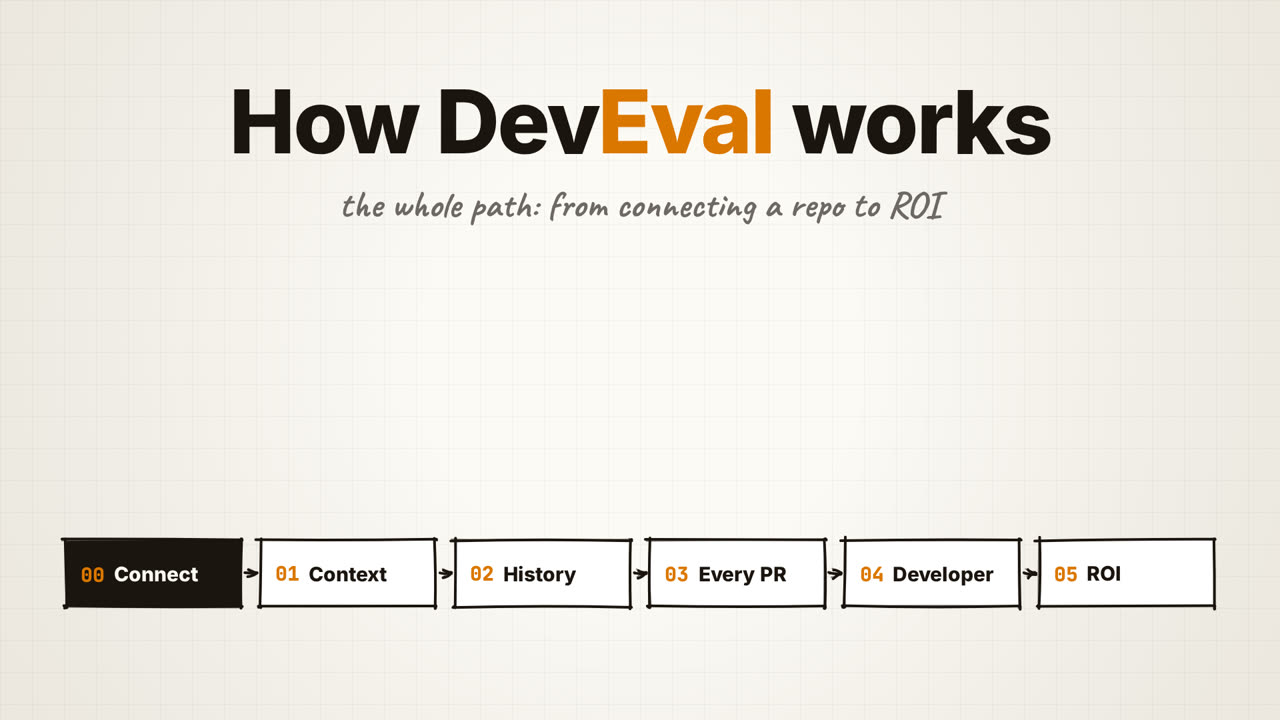
DevEval first learns what your projects actually are, then evaluates every merged PR against that context, then ranks developers head-to-head with reasoning. A built-in chat lets you skip clicking — it just reads the analysis already done for you.
It learns your codebase first.
Before any scoring, DevEval profiles each project — tech stack, criticality, era, complexity. A 3-line tweak in a simple CRUD app is not the same as one in a 24/7 banking core. Every later score is calibrated against this context.
Each merged PR is read like a senior reviewer would.
Every merged PR runs through seven layers: difficulty scoring (CU on 6 axes), effort estimate, classification, code-quality review, stability check, risk scan, and review-value attribution. One verdict per PR. Bug attribution traces regressions back to the introducing PR.
Pairs are compared, with reasoning.
"Alice > Bob in code quality, 87% confidence." Three rating systems for three questions. ROI per dev / project / client falls out of the same data.
Click around, or just ask.
Every screen is fully clickable — drill down to any PR, review, or ranking yourself. Or ask the chat: it reads the same data we already produced and assembles it for you, so you don't have to traverse five views to answer one question.
One scale. From a typo to a multi-sprint outlier.
CU is a measure of contribution per PR — comparable across people, teams, vendors, tools. Volume (scope) plus expertise bonuses on 5 axes. Same task = same CU, forever. AI-resistant by construction.
- 21 CRUD endpoint
- 45 screens (pattern)
- 7.5Multi-layer feature
- 11.5Vertical slice
- 14Senior foundations
- 17.5Infra greenfield
- 20Mid-dev sprint · 10 MD
- 24.5Multi-sprint epic
- 30Outlier (rare)
Built from 1 volume axis + 5 expertise bonuses.
Shipping fast with bad code is not a win.
Two delivery patterns. Same team. Same sprint. Velocity metrics call Dev A the top performer — DevEval doesn't. Quality, stability, and collaboration weigh more than raw volume by design.
Five places where the same data pays off.
One platform. One scoring model. Five concrete decisions it informs — from vendor renewals to hiring. The data is the same; the lens changes.
Three rating systems. Not a bug — a feature.
A chess grandmaster has three numbers: ELO 2400, top 5%, and games played — each answers a different question. So does DevEval. Plus a raw stat — Productivity Index — combining difficulty (CU) with working days. Not a ranking, just a measurement.
SaaS by default. Self-hosted when you need it.
Most teams run DevEval as a managed service and are productive in hours. Enterprises with stricter requirements deploy it inside their own perimeter — same product, same scores, your infrastructure and your AI key.
Per active developer. Self-hosted on Enterprise.
30-day trial without a card. After that your account turns read-only — nothing disappears. Enterprise is scoped and quoted per client.
Stop measuring lines of code.
Start measuring value.
Connect a repo in 15 minutes. Historic PRs backfilled the same day. Full ratings and ROI ready in hours.